
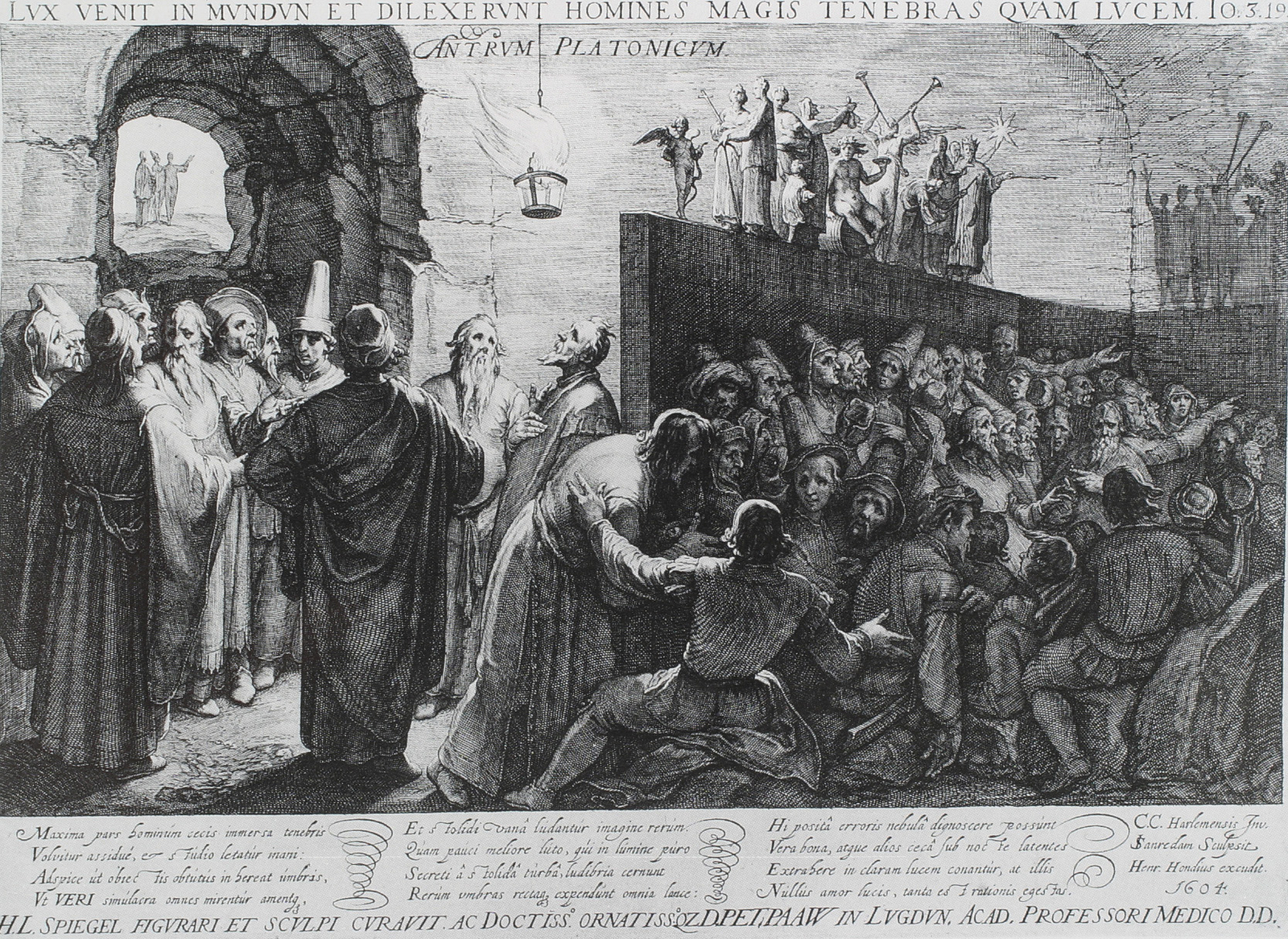
People facing a wall
In Book VII of the Republic, Plato asks us to imagine people chained inside an underground dwelling since childhood. They look straight ahead and cannot turn their heads. A fire burns behind them. Between the fire and the prisoners, other people carry objects whose shadows fall on the wall.
For the prisoners, these shadows make up the visible world. They name them, notice patterns and learn to predict which shadow will appear next.
When one prisoner is freed, turning towards the light is painful. Familiar images seem clearer than the objects now before him. The light outside the cave also takes time to get used to.
Returning is difficult: his eyes must readjust to the darkness, while those who stayed meet his account with disbelief. For Plato, the story concerns education and the soul's ascent towards knowledge. Here we are also interested in its structure: an image, its source, an observer and the attempt to share what has been seen.
Source: Plato, Republic, Book VII, 514a–517a; English translation by Benjamin Jowett. ↗
The same object.
A different shadow.
Projection size:
A schematic point light source. This illustrates how an object’s position affects its shadow; it is an explanatory model, not a reconstruction of Plato’s cave.
The shadow as a starting point
The story is usually retold as a passage from error to truth. When working with objects, it helps to linger with the shadow itself.
A shadow contains less than an object, but it retains a relationship with its source. Silhouettes, photographs, drawings, maps and digital models work in similar ways: each medium reveals something and conceals something else.
A useful question is: what part of the object disappeared when it became an image?
- A photograph has no weight.
- A drawing has no wear.
- A map has none of a place's smell or noise.
- A description lacks the immediate gesture.
- A model often lacks a history of its origins.
These losses can guide further inquiry. A photograph suggests what to examine. A drawing lets us check a dimension. Touch tells us about temperature, mass and the resistance of a material. Each observation adds to the last.
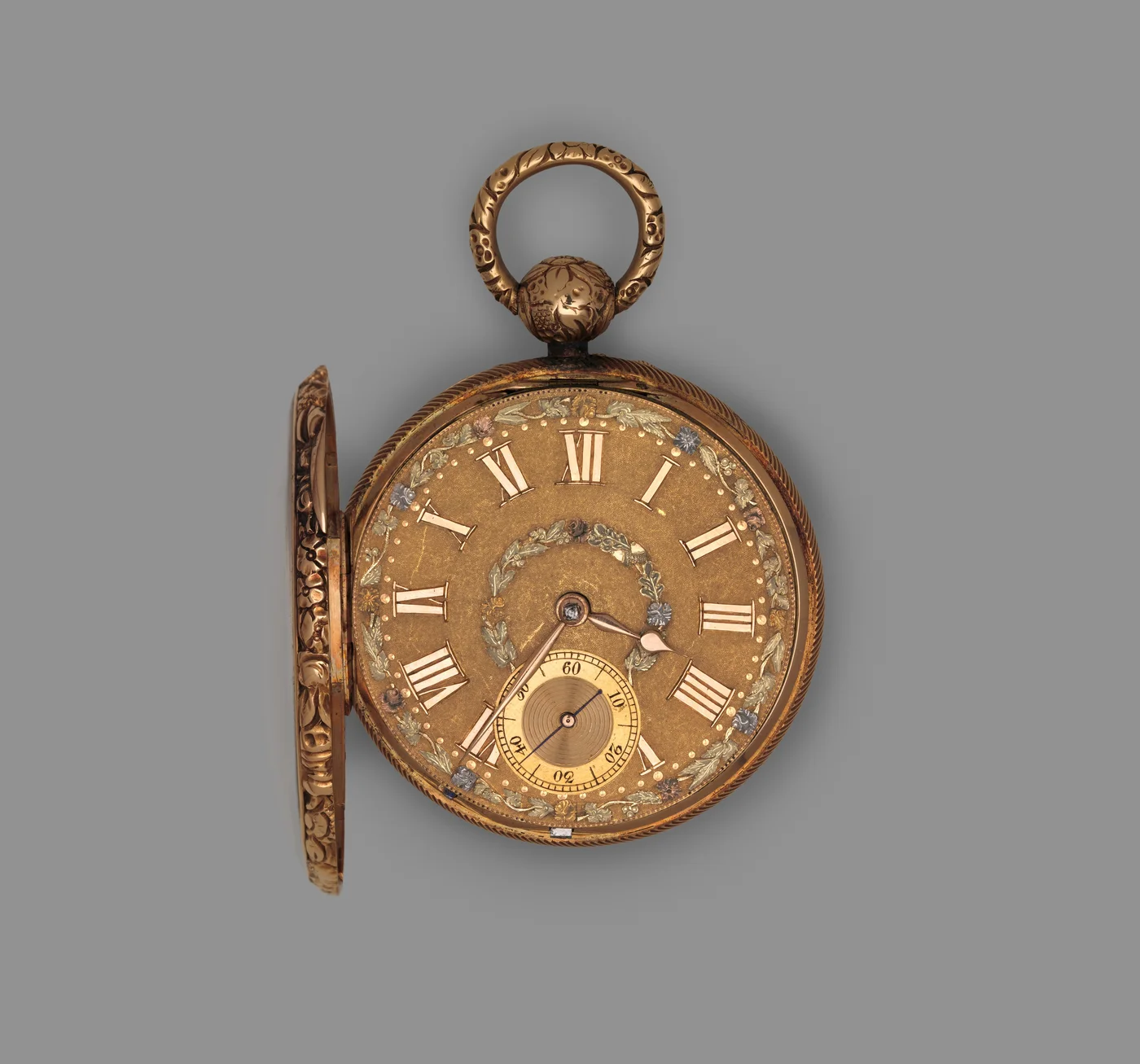
Photograph
Surface and light. Weight remains outside the frame.
Silhouette
An outline. Material and construction disappear.
Diagram
Relationships and proportions. The experience of touch is absent.
The gap in witnessing
Even someone who leaves the cave remains an observer with a language, a body, memories and limits. This is a question we bring to the myth from our own practice.
A witness selects, notices, forgets, compares and names. A gap therefore always remains between an object and its description.
This gap is useful. It keeps us from believing that a diagram exhausts reality. It also makes interpretation, art and disagreement possible.
An object can be presented very convincingly while leaving out what shapes the experience of handling it: an awkward edge, the sound of a joint, traces of repair. The thing resists its perfect image.
Returning with a language
Seeing is not enough. We must return and find a language that allows others to test our experience. This is where documents, lectures, models, demonstrations and repeatable experiments have a role.
The stronger the claim, the more important it is to show the path from observation to conclusion.
For a designer, such a return might take the form of a drawing, a specification, a material sample, an assembly photograph or a record of a failed test. Someone else can then follow the decision, repeat the action and notice what was missed.
A good document also preserves its gaps: what has been measured, what is assumed and what remains to be checked.
Specus: from shadow to object
In the cultural foundations of Specus, the cave becomes a place of inquiry and preservation. An object may first appear as a silhouette, a detail, an opening, a strange connection or a sense of form.
Then the work begins: gather the fragments, establish relationships, test the material and give the find a structure. This produces a sequence around which the project is built.
- Shadow.
- Fragment.
- Inquiry.
- Artefact.
- Archive.
This is an interpretation of the myth developed within the project. The shadow becomes the first trace from which the reconstruction of an object can begin.
The essay on watches approaches the same question through the dial. We see a circle, a centre and moving hands. Behind the familiar form, relationships emerge: a short cycle and a long one, the mechanism and the energy of the hand, an object and the habit of wearing it.
The two texts meet in one question: what does a visible form allow us to know, and what else must we do to understand the thing itself?
Questions that remain
- Is there a way of seeing without a cultural frame?
- Can an image become more convincing than the thing itself?
- Why does a technical drawing sometimes seem more honest than a photograph?
- What does experience lose when it becomes content?
- Can documentation show its own limitations?
These questions can be explored with a single object. Look at a photograph. Study a drawing. Hold the thing in your hands. At each step, note what has become accessible and what still escapes you.
